Leadership
Why Your Best Staff Keep Leaving: It's Not Pay, It's the System Around Them

Why Your Best Staff Keep Leaving: It's Not Pay, It's the System Around Them

“Why can’t I get reliable people?”
“Why does everything fall apart when I’m not there?”
“Do I have to keep hiring the same role every few months?”
If those thoughts sound familiar, it is easy to conclude that you have a staff problem. But when standards only hold while you are in the room, the bigger issue is usually the system around the team: leadership, clear expectations, manager development and accountability.
People experience your restaurant through the way it is run every shift. Your intentions do not set the rota, coach a new starter or resolve a conflict. Your managers do.
The owner’s presence is not an operating system
You know what good service looks like. You can spot a poor handover, a slow section or a kitchen slipping behind. So you step in. You correct it. You get through service.
Then you leave, and the same problems return.
That is the trap of working in the business instead of on it. Your experience keeps the operation moving, but it can also hide the gaps. If decisions, standards and follow-up depend on you being present, the team has not been given a repeatable way to get the job done.
Staff notice the difference. One manager enforces a standard; another lets it slide. One person gets feedback; another hears nothing until something goes wrong. The rota changes without warning. Good work goes unrecognised. Promotion is discussed vaguely, but no one knows what it takes to earn it.
That does not mean every resignation is the owner’s fault. It does mean that inconsistent management is a business issue you can address.
What the evidence says about why people stay or leave
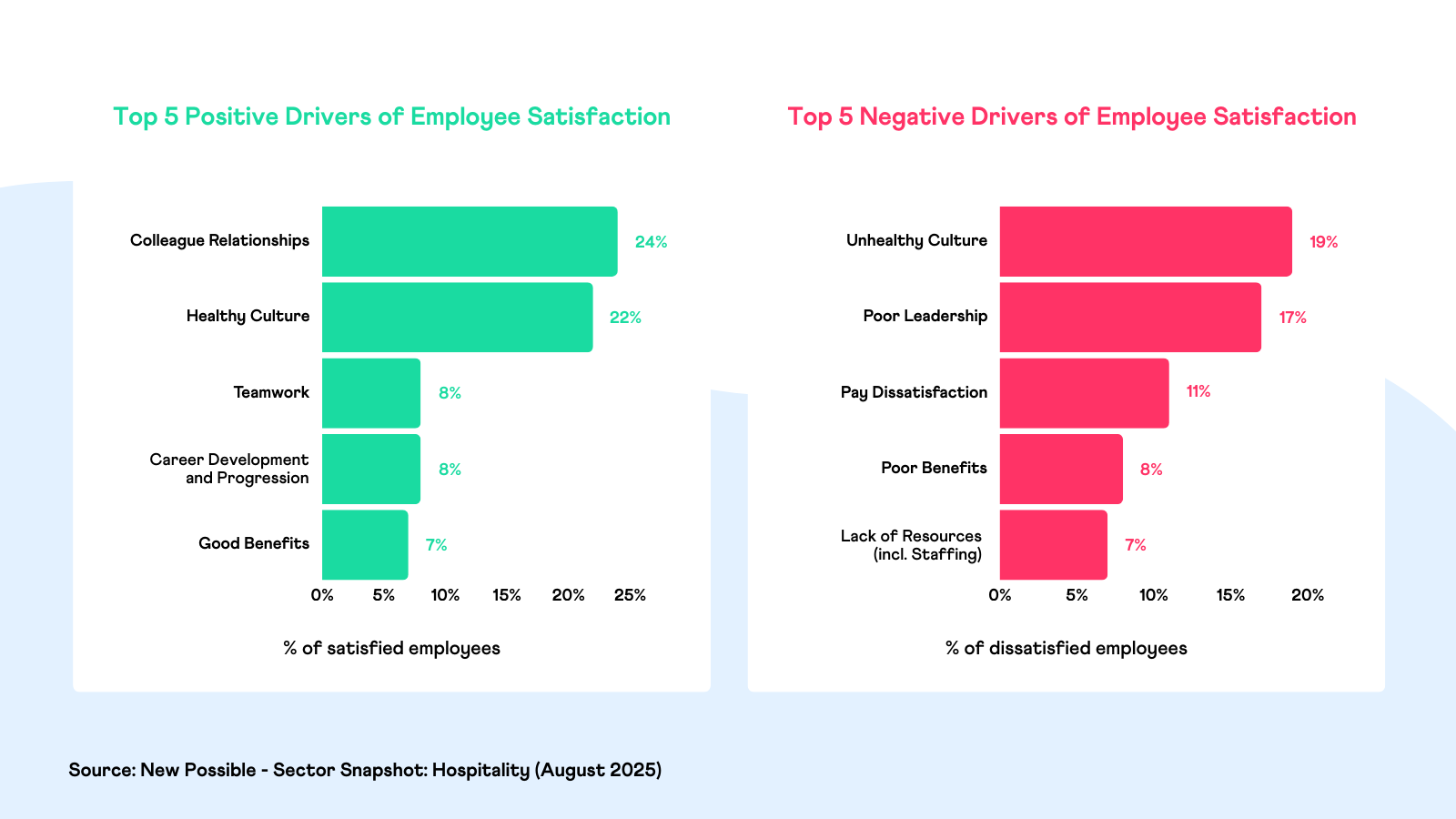
A UK hospitality snapshot based on feedback from 1,007 employees found that poor leadership and unhealthy culture were leading reasons people said they leave. Colleague relationships and a healthy, supportive culture were strong reasons to stay. In the same study, just 19% of restaurant employees said they were likely to recommend their employer as a place to work, compared with 25% across hospitality.
The findings do not say pay is irrelevant. It matters. But pay cannot compensate indefinitely for an uncaring or inconsistent workplace. The research also found that pay dissatisfaction was lower when people could see clear opportunities to progress. (New Possible’s UK Hospitality Snapshot)
The operating pressure is real, too. In an Axonify survey of 450 UK hospitality managers, long hours, stress and understaffing were identified as key causes of burnout. Managers said staffing shortages increased workloads for 73% of respondents and turnover for 60%. (Axonify’s 2024 survey findings)
That creates a damaging loop: vacancies add pressure to the people who stay; pressure weakens service and morale; and more people start looking elsewhere.
The difference between instinct and systems
Instinct tells you someone seems disengaged. A system helps you find out what is happening, respond fairly and check whether anything changes.
Instinct says, “We need better staff.” A system asks: Is the rota predictable? Does each shift have a clear leader? Are expectations written down? Do managers know how to give feedback, train people and handle problems? Can team members see a realistic route to more responsibility?
Without those answers, you recruit into the same conditions that drove people away.
You do not need a corporate HR department to improve this. You do need a few simple routines that happen consistently, not only when the owner has time.
Build manager routines that staff can rely on
Start with the moments people experience every week.
Set the shift up properly. Give the team a short briefing: who owns each area, what the service priorities are, where the pressure points may be and what to do if the plan changes.
Make standards visible. Put opening, service, handover and close-down expectations into practical checklists. A standard that exists only in someone’s head cannot be applied consistently by a whole team.
Schedule regular conversations. Short, focused one-to-ones give managers a chance to recognise good work, ask what is getting in the way and agree one next step. Do not wait for a resignation letter to learn that someone has felt ignored for months.
Show people how to progress. Define what someone needs to demonstrate to move from team member to senior, supervisor or assistant manager. Tie development to skills and responsibilities, not vague promises of “opportunity later”.
Close the loop. When a concern is raised, agree who will act, by when, and when you will follow up. Listening without follow-through weakens trust.
This is accountability, not blame. The aim is to make support and expectations reliable for the whole team.

Develop the manager, not just the employee
A strong chef is not automatically a strong people manager. A capable shift leader may know the menu and service inside out but still need support with coaching, fair delegation, difficult conversations and performance follow-up.
Promoting someone and hoping they work it out is not development. It is a gamble with the team’s daily experience.
Managers need clear authority, training and regular coaching. They also need to understand the commercial and operational decisions behind their role: how labour is planned, how service standards are protected, and how their decisions affect the business. Give them the skills, and the permission, to lead, then review whether they are doing it.
That is where working on the business begins. The owner stops being the only person who can spot a problem and set things right.
Use F.O.R.K. to connect people and performance
At GrowthFork, the F.O.R.K. System connects leadership with the disciplines that keep a restaurant operating consistently:
- F, Financial Control: Build understanding of the P&L, gross profit and cost control. Managers who understand the commercial picture can make better decisions, not just complete a shift.
- O, Operational Systems: Set clear routines for rotas, checklists, leadership, team culture and customer service. Make the right way to work repeatable.
- R, Revenue & Menu Design: Equip managers to understand how menu decisions, pricing and sales mix support the restaurant’s performance.
- K, Kitchen Engine Room only: Strengthen the kitchen’s workflow, preparation and execution so the team can deliver consistently under pressure.
These disciplines work together. A manager cannot protect a standard they have never been shown. A checklist cannot solve a workload problem if the rota is poorly planned. A training plan cannot build trust if managers fail to follow up.
The goal is not to add paperwork. It is to give people clarity, support and ownership, and give the owner visibility without requiring them to supervise every moment.

Ask a sharper question before you hire again
Before you post another vacancy, look at the pattern.
Who left? Which shift or team were they part of? What did they say in their exit conversation? Were their hours, responsibilities and development clear? Did they have a manager who checked in and followed through? Are standards the same when you are away?
Do not turn every departure into a verdict on your leadership. Use the information to find what the operation needs to change.
If your best people can only succeed when you are present, the business is relying on you, not on a system. That might feel like control. It is actually a constraint on your team and your ability to grow.
GrowthFork was built on more than 30 years of real-world hospitality leadership. We help independent restaurant, café and patisserie owners install practical systems and develop managers who can lead consistently. Explore how we work.
Start with the free Restaurant Profit Health Score to identify where your operation may be losing control. Then book a free 15-minute diagnostic call with Murat. Bring the problem you are seeing. Get an honest conversation about what may be driving it, without a pitch.
You cannot build a stable team on instinct alone. Install the system around them
Want this working in your restaurant?
Find your biggest profit leak with the free scorecard, or talk it through with Murat on a free 30-minute call.