Food Cost
The Back Door Rule: Restaurant Food Cost Control Starts at Delivery
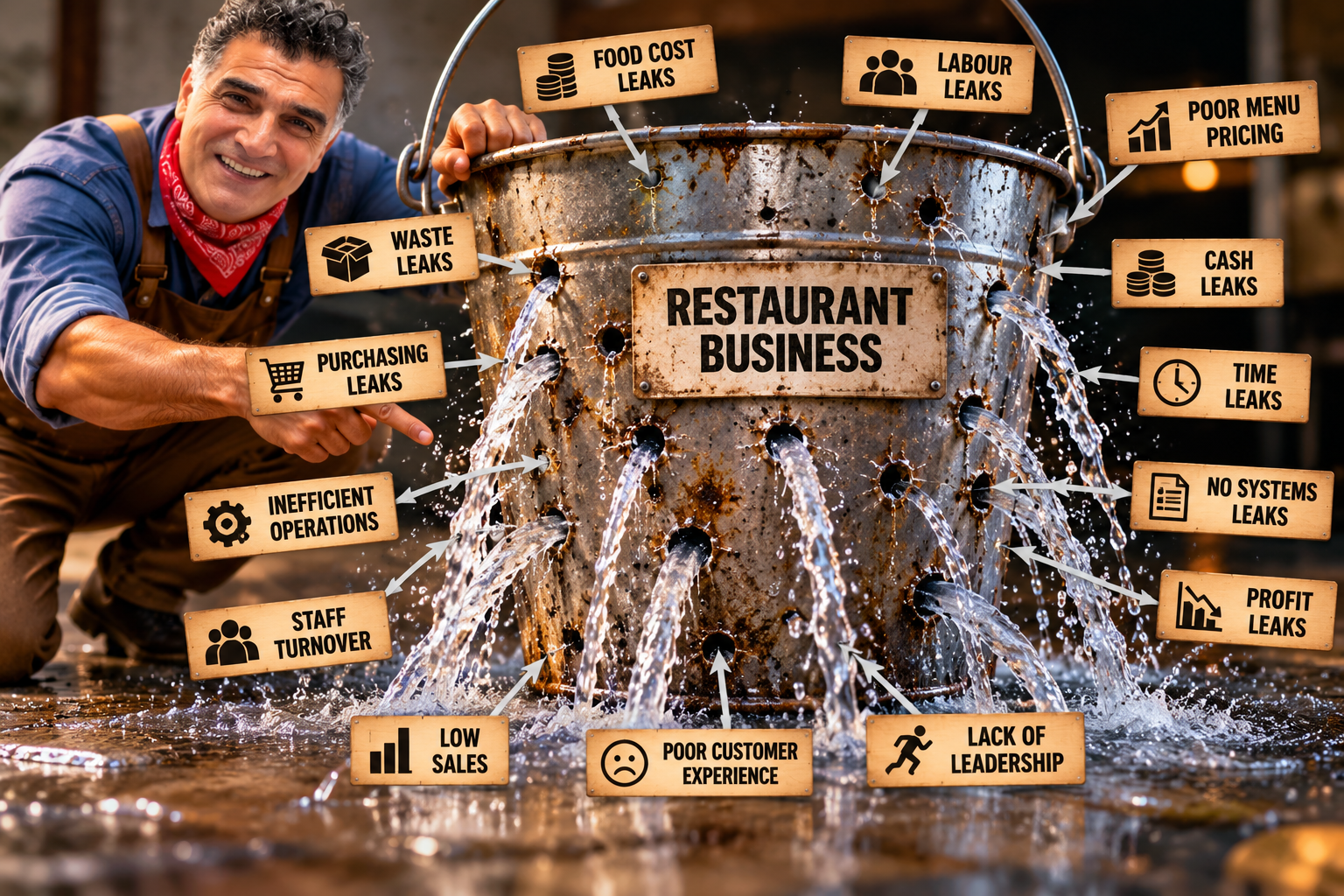
Restaurant food cost control starts at the back door, not on the menu. Every kilo of stock you pay for comes in through it, and most of the money independent restaurants lose on food cost leaks out there too: wrong prices on invoices, short weights and poor-quality deliveries that nobody checks. Fix your receiving system first and your gross profit improves before you change a single dish.
Most restaurant owners spend their energy at the front. The dining room. The menu. The customer experience. The Instagram photo of the latte art.
The best restaurant leader I ever worked with spent his first sixty seconds at the back. Every single time.
The Back Door Is Where the Money Enters, and Leaves
Peter was a big man. Former rugby player. The kind of presence that fills a room before he opens his mouth. He had his own key to the fire door at the back of every restaurant we ran together in Cape Town. He never announced when he was coming. He never walked in through the front.
Eight times out of ten, he came through the back door.
The moment that door opened, he was already scanning. Kitchen. Dry store. Cold room. Washing section. Salad prep. Grill. Coffee station. Dining room. Outside. Every section, in sequence, every time, and he moved fast. He believed the pace of the leader sets the pace of the building.
If anything was out of standard, he stopped. He called the manager. He called the section head. He did not shout. He taught, on the spot, in real time.
And if the back door itself was already open when he arrived, propped and unattended with nobody watching it, that was not an irritation. It was an issue. He would call the manager, the kitchen manager and the chef, and tell all of them clearly:
"Whenever this door is open, I want to see one of you standing here. This door does not stay unattended. Ever."
He was not being dramatic. He was being correct.
Restaurant Food Cost Control Starts at the Back Door
The back door is where your suppliers come in. It is where your stock enters the building, stock you have already paid for or are about to. It is where receiving happens, and receiving is one of the most important and most ignored systems in any restaurant or café.
Here is what happens when there is no system at the back door. A delivery arrives. The kitchen is busy. The driver is waiting. Whoever is nearest signs the note without checking the weight, the quality, or the price against what was agreed.
The invoice says £4.20 per kilo for chicken. The agreed price was £3.90. Thirty pence a kilo. The driver knows nobody is checking, and some suppliers count on it.
Do the maths. If you take 100kg of chicken a week, thirty pence a kilo is £30 a week. That is over £1,500 a year, from one product, from one supplier. Now spread that across every delivery and every supplier you use. That is not a small number. It is a serious, silent leak, and it is happening at your back door while you are arranging the front of house.
Block the First Hole
I call the back door the first hole. Every restaurant has holes, places where money leaks out quietly over time. The back door is almost always the first one, and it is the easiest to block if you have the system. In my F.O.R.K. IT method this sits right at the start, in the Find & Filter stage, where we audit supplier pricing before we touch anything else.
Here is what a proper back door receiving system looks like:
- The door is never unattended when open. Someone is always there. Always.
- Every delivery is received by a trained member of staff, not whoever happens to be nearby.
- Every item is weighed or counted. Not assumed. Checked.
- Every price on the invoice is checked against the agreed price list. Discrepancies are fixed on the spot, not later and not next week.
- Quality is inspected before anything is accepted. If a box of chicken is not at the right temperature, it goes back. If the lettuce is wilting, it goes back. Accepting substandard goods is not doing the supplier a favour. It is doing yourself damage.
- Everything is recorded: date, supplier, item, weight, price agreed, price charged, any discrepancy and any return.
That record is what turns a feeling ("I think the food cost is wrong") into a fact you can act on. Keep it on a clipboard, or in a stock and food cost system such as C.O.R.E. on our B.R.O.S.S. platform. What matters is that it is done every delivery.
You Cannot Send People to Fight Without Giving Them the Weapons
Peter used to say this, and I have never stopped saying it.
Your receiving staff cannot protect your margins if they do not know the agreed prices. They cannot send back a wrong delivery if they have never been shown what right looks like. You have to train them. You have to give them the price sheet. You have to show them, once, what happens when they push back on a supplier, and then let them do it.
I trained a receiving manager in Cape Town. I spent weeks with her, walking deliveries, checking invoices, showing her the gaps. One day a supplier arrived with nine boxes of chicken that were not at temperature. She sent all nine back. The driver argued. She did not move.
She had been given the bullet. She could fight.
That is what proper training at the back door looks like. Not a poster on the wall. A person who knows the standard, believes in it and holds it, even when the driver is arguing and the kitchen is shouting and it would be easier to sign the form and let it go.
The Standard You Walk Past Is the Standard You Accept
When Peter stopped coming to the restaurants as often, I did exactly what he had done. Back door first. Kitchen. Dry store. Cold room. Washing. Salad. Grill. Coffee. Dining room. Outside. Same sequence. Same speed.
I had copied him, and it worked, because the principle works, not the personality.
I trained every manager I ever had to understand this. If you walk past a dirty floor, you have just told your team that dirty floors are acceptable. If you walk past an open back door with nobody there, you have just told your team that the back door does not matter.
Everything communicates. Your walk-through, your sequence, your speed, your silence. The question is: what is it saying?
One More Story: The Tray
Our standard was simple: everything moves on a tray. Even a single glass. Even one cup of coffee. Not just in busy periods. Always.
New staff would sometimes forget, or test it, the way people test every standard when they are new, just to see if it really matters.
One afternoon a young waiter was carrying a glass in his hand. Peter saw it. He walked over, calm and friendly, no tension in his face, and called the young man over.
"Do you speak Spanish?"
"No."
"I can teach you. Repeat after me. Uno."
The young man repeated it. Peter nodded. "Duo." He repeated it. Peter nodded again. "Trio."
The moment the word left his mouth, Peter looked at him and said: "USE THE F***ING TRAY."
The whole restaurant laughed. The young man laughed. Peter laughed. And that young man never carried a glass without a tray again.
Peter understood something that takes most managers years to learn: people remember stories. They forget instructions. Teach through the story. Hold the standard. Make it memorable.
Where Do You Start?
If you own a restaurant or café and you do not have a back door system, start there. Today. Before the menu redesign. Before the marketing campaign. Before anything.
Block the first hole. Train the right person to stand at it. Give them the weapons to fight. And walk through the building every day, in sequence and at speed, until the standard you want becomes the standard that exists.
The front of house is where the customer sees you. The back of house is where your profit lives. Protect it.
Frequently Asked Questions
What is the first step in restaurant food cost control?
Check what comes in through the back door. Before you re-cost the menu or change portions, make sure every delivery is weighed or counted, checked for quality and checked against your agreed supplier prices. Overcharges and short weights at delivery inflate your food cost before a single plate is cooked.
How should a restaurant check a delivery?
A trained member of staff should weigh or count every item, check temperature and quality, compare every invoice price with the agreed price list, send back anything below standard, and record the date, supplier, item, weight, agreed price, charged price and any discrepancy.
Who should receive deliveries in a restaurant or café?
One or two named, trained people who have the agreed price list and the authority to refuse goods. Not whoever is nearest the door. If the person signing the delivery note cannot say no to the driver, you do not have a receiving system.
How much can supplier overcharging cost a restaurant?
More than most owners think. As an example, thirty pence per kilo over the agreed price on 100kg of chicken a week is £30 a week, or over £1,500 a year, from one product and one supplier. Across all your suppliers, unchecked deliveries can quietly take thousands off your gross profit.
Is there a restaurant consultant who can help with food cost near me?
Growth Fork works hands-on with independent restaurants and cafés across Reading, Berkshire, Oxford and London, and remotely across the UK. We start by finding your biggest profit leak, then install the systems and train your team and GM to hold them.
Find Your Biggest Profit Leak, Free
Is your back door your first hole, or is it something else? The free Restaurant Profit Protection Scorecard takes about five minutes and scores your restaurant on the 7 skills that protect profit, then emails you your full report.
Take the free Profit Protection Scorecard →
Want the system installed in your restaurant rather than just described? See how Growth Fork works with restaurants and cafés.
Murat Yilmaz is the founder of Growth Fork Ltd, a restaurant consultancy based in Reading, UK. With 35+ years leading hospitality in Turkey, South Africa and the UK, he works hands-on with independent restaurant and café owners across Reading, Berkshire, Oxford and London to fix profit leaks, build real systems and turn managers into commercial GMs. He is an ABM certified business mentor and an Enterprise Nation business adviser.
Want this working in your restaurant?
Find your biggest profit leak with the free scorecard, or talk it through with Murat on a free 30-minute call.